
When completing or remodelling a basement in Canada, your windows need to comply with particular egress window size standards as outlined by the building code. These regulations guarantee secure emergency evacuation and access for firefighters. Not complying with the legal basement window size requirements in Ontario can lead to permit denials and pose significant safety hazards.
- According to the Ontario Building Code, an egress window must feature an open area of at least 0.35 m² (3.77 ft²) that is free from obstructions, and no specific measurement (either height or width) can be under 380 mm (15 inches).
- A typical basement window tends to be small and designed solely for illumination and airflow. A compliant egress window adheres to the Ontario Building Code and is sufficiently sized for a safe emergency exit.
- The size of a basement egress window is determined by its clear opening since building codes emphasize the actual space available for escape rather than the window frame.
- Wells and barriers influence compliance by altering the flow of air, water, or structural loads within an area.
- Expert installation from Vinyl Light guarantees that your egress window complies with local building code size regulations by adhering to the standards set by the Ontario Building Code, ensuring correct dimensions, window well size, and clear space, helping you prevent unsuccessful inspections, penalties, or safety hazards.
What Is an Egress Window and Why Does Size Matter?
- An egress window size indicates the minimum unobstructed opening needed for a window to function as an emergency escape.
- The purposes of egress windows are:
- an individual to securely exit in an emergency;
- a firefighter to access the house with gear.
- In Canada, including Ontario, building codes mandate that every floor must have at least one exit option. For basement window sizes, this typically refers to an adequately sized egress window, which is something different than a standard basement window size.
- How the basement egress window size is calculated:
- Completely open the window. It should be able to be opened without the use of tools or any specific expertise.
- Determine the width of the unobstructed opening. It refers to the unobstructed horizontal measurement between the inside edges of the open sash.
- Determine the height of the unobstructed opening. The upright clear area when entirely opened.
- Multiply height by width.
- Operability impacts egress window compliance since building codes evaluate the clear opening when the window is completely open, rather than the total window dimensions. An egress window needs to open sufficiently to ensure the minimum clear opening area needed for emergency exit. If the window type, such as sliding or single-hung, only opens halfway, it might not satisfy the necessary opening, even if the entire window appears sufficiently large.
Additional value: Widespread misconception: numerous individuals believe that the size of the glass matches the necessary egress opening dimensions. But this is not accurate.
Egress Window Size Requirements in Ontario
-
The official egress window size Ontario requirements are:
- Minimum unobstructed opening area: 0.35 m² (3.77 ft²) when the window is completely opened.
- Minimum clear measurement: 380 mm (15 in), for both width and height must not be below this.
-
Egress windows operation:
- Should be operable from the interior without tools, keys, or specialized knowledge.
- Must stay open without requiring any support (no additional assistance).
- Necessary for any floor which has a bedroom unless a door at that same level leads directly outside.
-
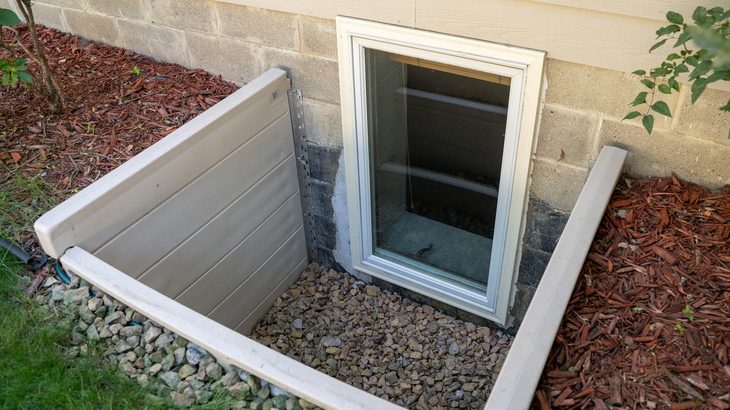
Window well clearance requirements:
- If the egress window opens into a well, the egress window minimum size should be at least 550 mm (≈ 22 in) of clear space between the fully open window and the wall of the well for escape.
- If the sash moves toward the well, its movement should not obstruct this clear path.
A complete list of requirements you can find here.
Additional value: Numerous older homes feature small basement windows that satisfy lighting and ventilation standards but fail to comply with building code egress window size. To update them to the current legal basement window size, Ontario code, you will frequently have to cut into the foundation, widen the rough opening, and install a larger window along with an egress well.
Standard Egress Window Size vs Standard Basement Window Size
In Ontario, basement egress window size is required to adhere to the minimum egress standards set by the Ontario Building Code.
| Standard egress window size | Standard basement window size | Older hopper or slider styles | Modern casement windows |
|---|---|---|---|
|
Clear operable space: ≥ 0.35 m² (≈ 3.77 sq ft) No measurement (width or height) below 380 mm (15 in) Functional without tools and remains open without assistance. |
Standard basement windows (e.g., small sliders, awnings, hoppers) are generally about 24x48 inches wide by 24x36 inches high, primarily intended for light and ventilation rather than for meeting exit requirements. |
Hopper windows, hinged at the bottom, typically open only slightly inward, providing a restricted clear opening - generally insufficient for egress unless designed specifically for that purpose. Standard sliding windows can only have one half opened at a time; to satisfy egress requirements, they must be considerably larger than a casement with the same rated opening. |
Casement windows are typically the optimal option for compliance since the sash opens completely, maximizing the unobstructed opening space. Common dimensions such as 28×40, 30×48, and 32×48 frequently offer sufficient clear openings to satisfy the minimum egress area, ensuring no measurement falls below 15 in. It's simpler to comply with code using a smaller frame size than sliders, as every opening aids in escape. |
| Feature | Standard basement window size | Standard egress window size |
|---|---|---|
| Clear opening | Frequently smaller; might not satisfy the 0.35 m² unobstructed opening criteria. | At least 0.35 m² (3.77 sq. ft.) of clear opening; minimum dimensions of 380 mm in both height and width. |
| Emergency escape | Typically insufficient in size for a secure exit. | Indeed – engineered for secure evacuation during emergencies. |
| Code approved for bedrooms | No - unless it satisfies egress size criteria. | Yes – mandated for basement bedrooms according to the Ontario Building Code. |
| Firefighter access | Generally too narrow for safe access. | Yes – permits firefighters to access with gear. |
Additional value: Why casement windows are often preferred for maximizing opening. Casement windows are frequently utilized for egress due to:
- The whole sash moves outward.
- They offer a bigger unobstructed space in comparison to sliding or single-hung windows with the same frame dimensions.
- The opening is not limited by having half the frame stationary (unlike sliders).
Basement Window Sizes in Older Canadian Homes
Houses constructed during the 1960s to 1980s generally feature small sliding or hopper windows in the basement. Typical basement window sizes were approximately 30" x 12" or 24" x 16", intended primarily for illumination and limited airflow, and not as an emergency exit. Many older windows do not comply with the current legal basement window size Ontario requirements.
Older houses feature poured concrete or block foundations with small original windows. Expanding the aperture necessitates: slicing concrete, setting up an appropriate header for load distribution, incorporating drainage and a suitable window well. Removing concrete without structural support can compromise the foundation and lead to cracking or settling.
Additional value: The most important implications of retrofitting vs. new construction are:
- Retrofitting: requires foundation cutting, necessitates structural engineering and support, increases expense, and must comply with existing egress window minimum size regulations.
- New construction: openings are structured to comply with all codes, simplify compliance, reduce structural risk, and be more economical.
Common Mistakes That Lead to Non-Compliance
Improving a basement bedroom can result in several mistakes that could cause your window to fail to comply with building regulations:
- The frame measures rather than the clear opening. The egress window size is determined by the actual clear opening when the window is fully opened, and not the dimensions of the glass or frame. This frequently leads to not meeting egress window minimum size.
- Slider instead of casement. Slider windows generally open to only half their width, limiting the visible opening space. Casement windows open completely and are more prone to satisfy the necessary egress window dimensions.
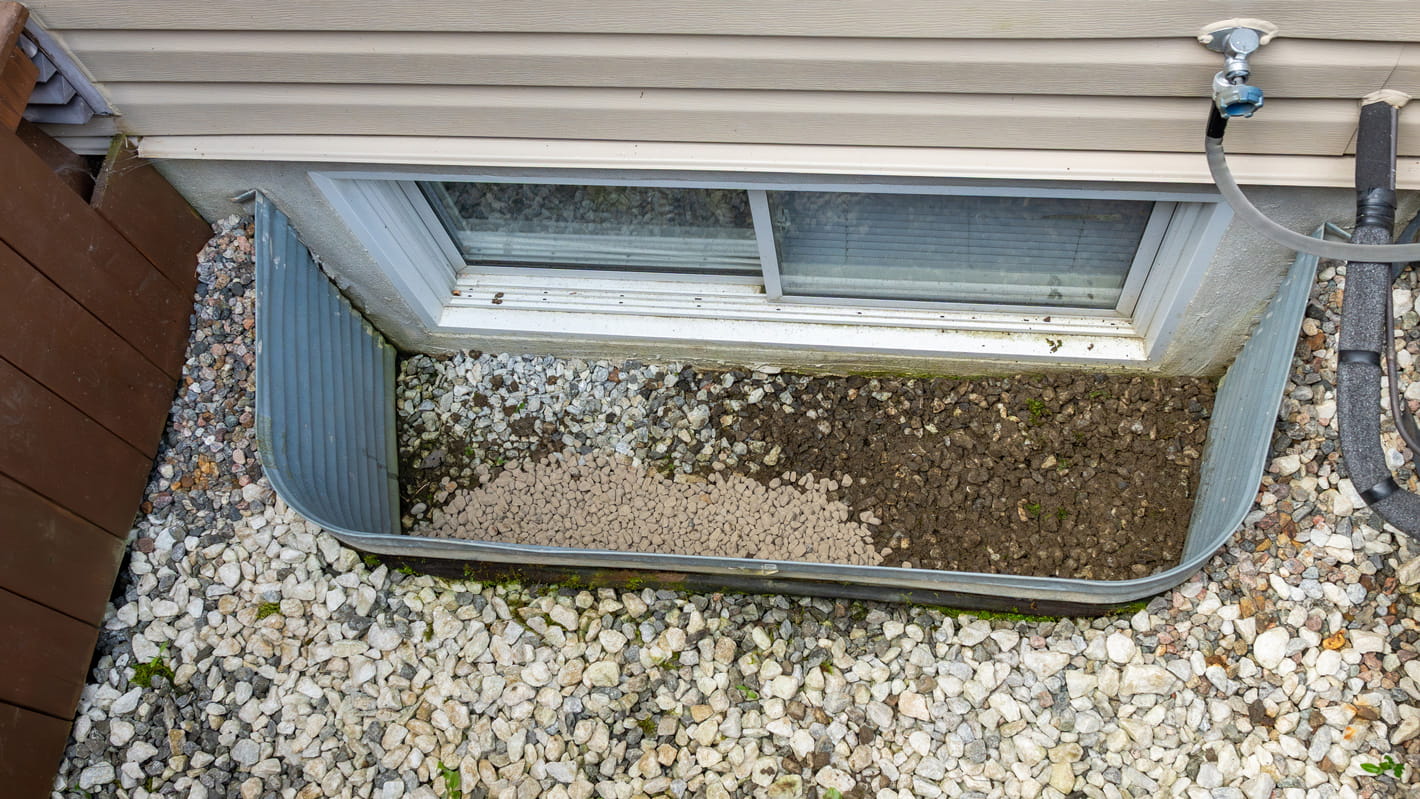
- Disregarding window well spacing. Although the window itself satisfies the minimum size for egress, the inadequate depth of the window well (minimum 550 mm in Ontario) may render it non-compliant.
- Installing fixed windows. Egress windows should be operable without the use of tools, keys, or specialized knowledge. Fixed units automatically violate compliance.
- Neglecting municipal amendments. Municipalities in Ontario governed by the Building Code may impose extra requirements that exceed provincial standards.
Additional value: Not adhering to the specified egress window dimensions may lead to permit and inspection consequences, such as:
- False inspection,
- Problems during residential sales or insurance requests,
- Holds of completing or leasing the basement,
- Order to remove and reinstall.
How Proper Installation Ensures Code Compliance
- Permit process in Ontario. Most enlargements of basement windows necessitate a building permit. Plans should indicate the intended opening dimensions, structural support specifications, and adherence to the legal basement window size Ontario requirements. Inspections verify that the window complies with the code prior to approval.
- Engineering considerations for cut-outs. Widening a foundation opening typically necessitates the installation of a correctly sized lintel to bear the weight overhead. Cutting concrete without proper structural planning may weaken the wall and lead to cracking or settling.
- Waterproofing after enlargement. After cutting the foundation, proper sealing, flashing, and exterior membrane protection are essential to prevent leaks. Inadequate waterproofing can result in lasting moisture issues and mold growth.
- Insulation around the new opening. Proper air sealing and insulation are essential to avoid drafts and condensation, ensuring comfort and energy efficiency.
- Why DIY can be risky. DIY installations frequently misjudge clear opening (gauging frame rather than true opening), bypass permits, or neglect structural support, resulting in unsuccessful inspections, penalties, or expensive repairs.
Additional value: Vinyl Light is experienced in Ontario's code compliance, structural retrofits, guaranteeing that basement renovations fulfill safety criteria and succeed in inspections on the initial attempt. Contact us to get a consultation on your future project with the proper egress window size Ontario requirements.
Why Work with Vinyl Light for Basement Window Compliance
Vinyl Light Windows & Doors is knowledgeable about the Ontario Building Code standards, ensuring adherence to the correct egress window sizes. We know the housing styles in local neighbourhoods, acknowledging traditional home designs and building limitations in the Toronto area and Etobicoke. We are manufacturing windows in custom dimensions to satisfy the egress window size regulations in Ontario. Our installers ensure correct waterproofing and structural reinforcement, enhancing and sealing to comply with inspection criteria.
A recent project in Etobicoke involves a vintage bungalow upgraded from a small sliding window to a compliant casement, in line with the current Ontario regulations and standards.