
If you are replacing or upgrading a garage door in the GTA, insulated garage doors keep attached garages warmer, cut noise, and protect anything stored or parked inside. The right choice depends on the R-value, the door style, and how the garage is actually used, not just the price on the quote.
For homeowners with a garage attached to living space, or anyone who uses the garage as a workshop through the winter, insulation is one of the few upgrades that pays off in comfort almost immediately. This guide explains what insulated garage doors are, how to read an R-value, the styles Vinyl Light offers across the GTA, and what realistic pricing looks like.
It is also one of the more overlooked home upgrades. Homeowners will happily invest in new windows or a new entry door but leave a decades-old, uninsulated garage door in place, even when it is one of the largest single openings on the house. Understanding what actually changes with an insulated door helps put the upgrade in proper context alongside the rest of the home's exterior.
Key Takeaways
- An insulated garage door has a foam core between its outer skins, unlike a standard hollow door.
- R-value measures resistance to heat flow, but a higher number is not automatically the right choice for every garage.
- Vinyl Light offers raised-panel, carriage-style, and modern flush garage doors across the GTA, each with different insulation options.
- Insulated garage doors carry a realistic price range in Toronto and the GTA depending on size and insulation tier.
- The upgrade pays off fastest on attached garages with living space above or beside them, and matters less on a detached storage garage.
What Does "Insulated" Actually Mean for a Garage Door?
An insulated garage door has a foam core sandwiched between two outer skins, usually steel, vinyl, or fibreglass. That core separates an insulated garage door from a standard hollow-panel door, which has only air between the front and back of each section.
Construction generally falls into three tiers. Single-layer doors have no insulation. Double-layer doors add a foam backing to a single steel skin. Triple-layer doors sandwich the foam core between two full skins, which gives premium doors a higher R-value and a stiffer, quieter panel.
The foam itself is usually polystyrene or polyurethane. Polystyrene is the more affordable option and is glued or clipped into the panel. Polyurethane is injected as a liquid that expands to fill the entire cavity, bonding it to both skins and typically delivering a higher R-value for the same panel thickness.
The skins themselves also affect performance and price. Steel skins are the most common and the most affordable; vinyl skins add corrosion resistance for coastal-style exposure, and fibreglass skins are typically chosen for a wood-look finish that still resists the dents and warping real wood is prone to.
Insulation affects more than temperature. A foam-core door is also noticeably quieter to open and close, and far more resistant to the dents and dings a hollow steel door picks up over the years.
R-Value Explained: What Number Actually Matters
Garage door R-value measures how well the door resists heat flow. It is tested under standardized conditions and reported as a single number for the assembled panel, not just the foam. A higher R-value means less heat moves through the door in either direction.
Entry-level insulated garage doors typically fall in the R-6 to R-9 range, using polystyrene panels of modest thickness. Premium triple-layer doors with polyurethane cores commonly reach R-16 to R-20 or higher, depending on the manufacturer and panel thickness.
The garage door R-value matters most when the garage shares a wall or ceiling with living space, a bedroom above the garage or a mudroom beside it, for example. In that situation, a poorly insulated door acts like a large gap in the building envelope, and the difference between a low and high R-value shows up directly in the adjacent rooms.
It helps to remember that R-value is only one part of overall performance. The seal around the door, the weatherstripping at the bottom, and how tightly the panels fit together when closed all affect real-world heat loss just as much as the foam core itself, which is why a mid-range door installed well can outperform a high R-value door installed poorly.
A detached garage used only for storage rarely needs the highest R-value on the market. The right number depends on how the space is actually used, not on chasing the biggest figure available.
Garage Door Styles Available in the GTA
Vinyl Light offers several garage door styles for GTA homes, and insulation options vary by style and panel construction rather than by a single fixed spec.
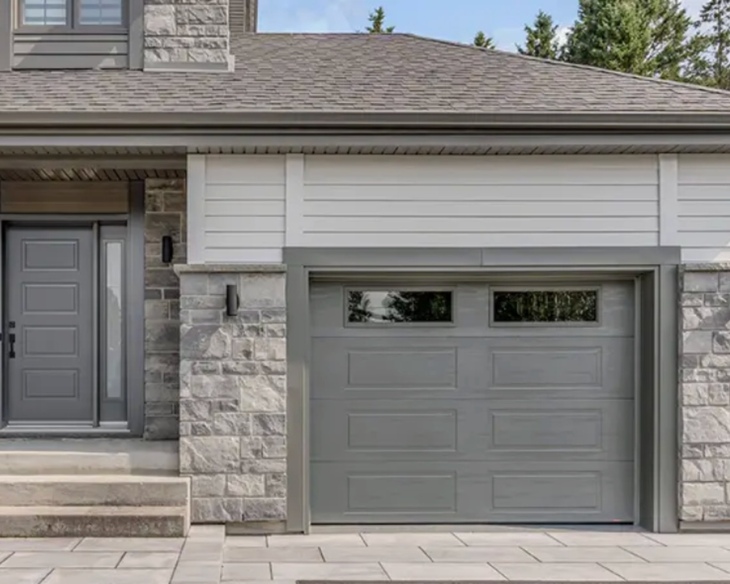
- Traditional raised-panel doors, the most common style on GTA streets, available in a wide range of insulation tiers
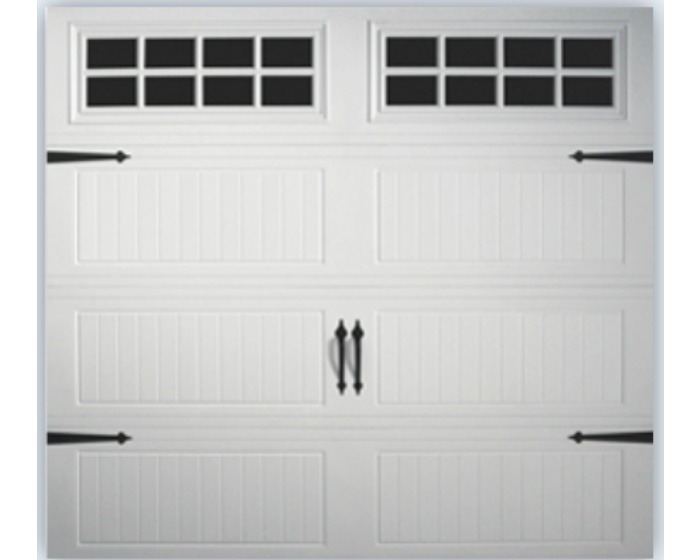
- Carriage-style doors that mimic swing-out barn doors while operating on a standard track, popular on traditional and character homes
- Modern flush or full-view doors with clean lines or large glass sections, common on contemporary builds
Style choice can affect insulation options. Full-view doors with large glass panels, for example, typically insulate to a lower R-value than a solid raised-panel door of the same thickness, since glass conducts heat differently than a foam-filled steel panel.
What Insulated Garage Doors Cost in Toronto and the GTA
Pricing for insulated garage doors depends on door size, insulation tier, and finish. A single-car door generally costs less than a double-car door of the same construction, and moving from an entry-level to a premium insulation package adds to the base price.
Several factors push the final quote higher: windows built into the panel, a custom colour outside the standard range, a higher R-value core, and a smart opener with camera or app integration all add cost on top of the base door.
Installation also affects the total. Replacing an existing door on a standard opening is generally straightforward, while a new opening, a non-standard size, or added structural work to the header will increase labour and materials.
Insulated vs. Non-Insulated: Is the Upgrade Worth It?
A standard, uninsulated garage door loses heat quickly in winter. In an attached garage, that heat loss doesn't stay contained. It pulls warmth from the rooms next to and above the garage, which shows up as a cold floor in a bedroom above or a mudroom that never quite warms up.
The effect compounds over a full GTA winter. A garage that swings close to outdoor temperature overnight forces the furnace or heat pump to work harder to keep adjacent rooms comfortable, and that added load shows up gradually on energy bills rather than as one obvious spike.
Upgrading to an insulated garage door reduces that heat exchange and keeps the garage itself closer to a usable temperature, which matters if it doubles as a workshop, gym space, or parking for a vehicle you want to start easily on a cold morning.
- Less heat loss through the garage into adjacent living space
- A more stable temperature inside the garage itself
- Noticeably lower noise transfer, both from outside in and from the garage into the house
Why Work with Vinyl Light for Your Garage Door
Vinyl Light manufactures and installs windows and doors across the GTA, so a new garage door can match the colour and style of the home's existing windows and entry door instead of being chosen in isolation.
Local support extends past installation day, with warranty and service backed by a team that knows the product and the GTA climate it has to perform in.