
A separate basement entrance turns dead square footage into the most valuable space in your house, a legal rental unit, an in-law suite, or a finished basement you actually want to use. But the door at the bottom of those concrete steps is what makes or breaks the project. Wrong material, and you fight moisture for years. Wrong security spec, and you advertise the easiest break-in point on the property. This guide covers the choices that matter for Toronto and GTA homes in 2026.
Key Takeaways
- A walkout basement door is a full-size exterior door at the bottom of a separate stairway, providing direct ground-level access to a basement.
- The four main types are single side doors, French doors, sliding glass doors, and bulkhead (cellar) doors — each suited to a different use case.
- Steel and fibreglass are the two materials that handle Ontario's moisture and freeze-thaw cycles; wood is rarely a good choice for below-grade doors.
- Toronto requires a building permit and zoning compliance for any new separate basement entrance, plus a structural review if load-bearing walls are affected.
- A typical 2026 installed cost for a complete separate-entrance project in Toronto/GTA runs $8,000–$25,000+, with the door itself accounting for $2,000–$5,000 of that total.
- Basement entrance doors face a higher risk of break-ins than front doors — security upgrades should be in the budget from day one.
What Is a Walkout Basement Door?
A walkout basement door is a full-height exterior door at ground level that opens directly into a basement. It gives the basement the same kind of entrance that the rest of the house has, no awkward hatch, no interior stairs from above.
There are two ways a walkout entrance happens:
- Natural walkout — the lot slopes, so the back or side of the basement is already at or above grade. The door sits in the basement wall and opens onto the yard or patio.
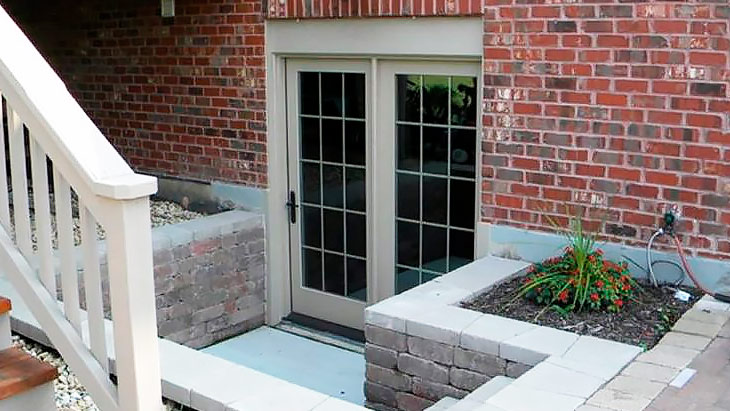
- Cut-out walkout — the basement is below grade, a stairwell is excavated alongside the foundation, and a new opening is cut into the concrete wall.
The second type is far more common in Toronto and the GTA, where most lots are level. A basement wall cut-out is a structural project that includes concrete cutting, drainage, structural reinforcement, and finishing, all of which must be done correctly for the door to perform well over the long term.
Types of Basement Entrance Doors
| Door Type | Best Use | Light & View | Security | Typical Installed Cost |
|---|---|---|---|---|
| Single side door (steel/fibreglass) | Rental unit, in-law suite, secured entry | Low (optional glass insert) | Highest | $2,000 – $4,000 |
| French double doors | Walkout to patio or deck | Very high | Medium-high | $4,000 – $7,000 |
| Sliding patio door | Wide openings, indoor-outdoor flow | Maximum | Medium | $2,000 – $5,500 |
| Bulkhead/cellar door | Utility access, older homes | None | Low to medium | $2,000 – $4,500 |
Single Side Doors
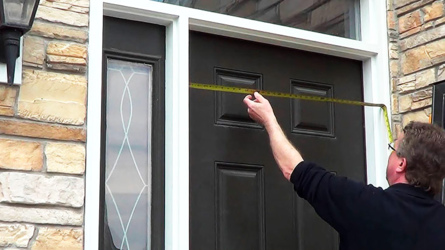
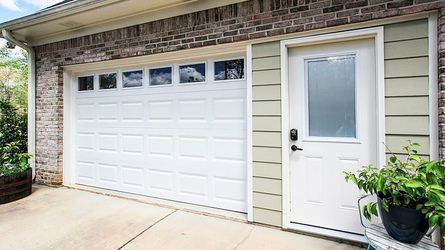
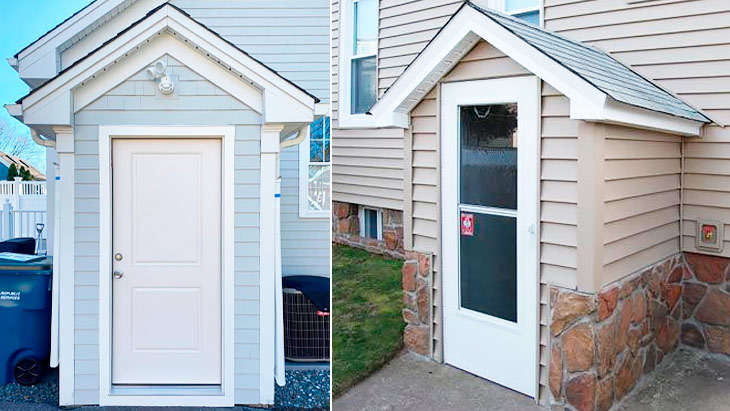
The standard choice for a separate basement entrance with a stairwell cut-out. A steel or fibreglass slab, usually 32" or 34" × 80", pre-hung in a reinforced frame with a deadbolt and ideally a multi-point lock. For rental units where security is the priority, a solid slab with no glass is the most defensible spec. Add a sidelight if the staircase feels dark.
French Double Doors
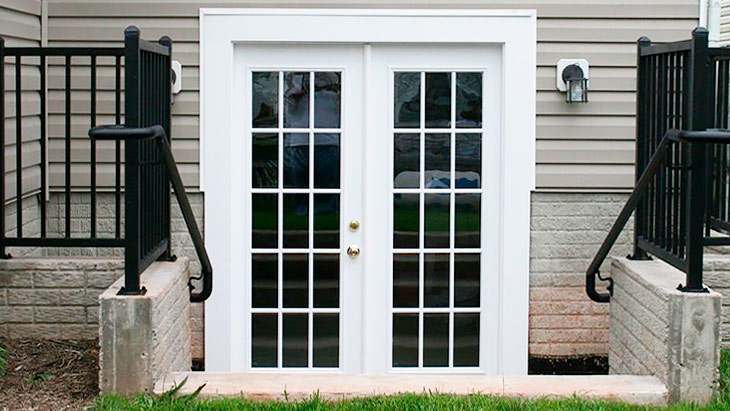
Two hinged panels with full-height glass. Best for natural walkout basements opening directly onto a deck or patio. One panel serves as the daily door; both open to move furniture. French doors deliver the most natural light of any configuration and make finished basements feel like ground-floor space.
Sliding Patio Doors
Glass panels moving horizontally on a track, usually 5, 6, or 8 feet wide. Excellent for walkouts with wider openings and the practical choice when interior swing space is limited. A modern sliding patio door with Low-E glass, Argon fill, and a multi-point lock matches the security of a hinged door while delivering far more daylight.
Bulkhead (Cellar) Doors
Angled metal doors covering an exterior stairway down to the basement — the old "Bilco-style" hatch. Common in Toronto homes built before 1960. They work as utility access but are not suitable as the main entrance to a finished basement or rental unit. Most renovations today replace bulkheads with a full walkout cut-out.
Best Door Materials for Basement Entrances
Basements are damp by definition, with concrete walls, ground moisture, and freeze-thaw cycles. The material has to withstand conditions that would destroy a poorly chosen above-grade door in five years.
| Material | Moisture Resistance | Insulation (R-value) | Security | Maintenance | Recommended for |
|---|---|---|---|---|---|
| Steel | Good (with quality finish) | R-10 | Highest | Low | Rental units, secure entries |
| Fibreglass | Excellent | R-15+ | High | Very low | Most walkout basements |
| Wood | Poor | R-6 | Medium | High | Covered, above-grade entries only |
| Composite | Very good | R-10–14 | High | Low | Mid-range, utility doors |
- Fibreglass is the most recommended material for new basement entrance doors. It does not rot, swell, or rust, handles condensation cycles without warping, and carries the highest insulation value of any residential door.
- Steel is the best value when security is the top priority. Insulated steel slabs resist forced entry better than any other residential material and cost less than fibreglass. The painted finish can rust if scratched and exposed to moisture for years.
- Wood and composite make sense only for protected entrances under a covered porch or roofed stairwell.
Glass Options for Basement Entrance Doors
Glass turns a dark basement stairwell into usable space, but the choice matters more here than on a front door:
- Privacy / sandblasted glass — diffuses light while blocking the view from outside. Standard for ground-level basement doors visible from a neighbour's yard.
- Tempered or laminated glass — required by Ontario code for full-height glass exterior doors; strongly recommended for any basement door with a glass insert.
- Sidelites — vertical glass panels beside the door. The most cost-effective way to bring daylight into a windowless stairway.
All glass on a basement entrance door should be double-glazed with Low-E coating, and Argon fill at a minimum. Triple glazing is worth specifying for north-facing windows or deep stairwells.
Permits for a Separate Basement Entrance in Toronto
A new separate basement entrance always requires permits in Toronto and most GTA municipalities. Expect four documents:
- Building permit — required for excavation, concrete cutting, foundation modification, or new exterior openings.
- Zoning approval — confirms the entrance does not violate setback rules, lot coverage, or restrictions on secondary suites.
- Structural engineer's review — required when the cut-out affects a load-bearing wall, which is the case for most foundation walls in Toronto homes.
- Final inspection — confirms code compliance before the entrance is approved for use.
If the basement will function as a secondary suite (legal apartment), additional fire safety, egress, ventilation, and minimum ceiling height standards apply under the Ontario Building Code. The door, windows, and staircase all need to meet egress requirements from the design stage forward.
Verifying zoning and permit requirements with your municipality before starting design is the cheapest insurance on this kind of project.
How to Secure an Outside Basement Door
A separate basement entrance is the highest-risk entry point on the property; it faces away from the street, is screened by landscaping, and homeowners often skip security upgrades they would never skip on the front door. Six upgrades worth specifying from day one:
- Solid steel or fibreglass slab — never a hollow-core door.
- Multi-point locking system that engages the frame in 3+ points with a single handle turn — far more effective than a deadbolt alone.
- Grade 1 or Grade 2 deadbolt with a 1-inch throw and a reinforced strike plate secured with 3-inch screws into the framing studs.
- Smart lock or keypad entry — eliminates the need for hidden keys and logs every entry. Essential for rental units.
- Motion-sensor lighting above the stairwell — one of the strongest deterrents at a shadowed entrance.
- Tempered or laminated glass on any door with a glass insert.
Pros and Cons of a Walkout Basement Entrance
Pros:
- Adds significant property value — Toronto homes with legal walkout basements sell at a premium and are easier to list as rental income properties.
- Enables a legal rental unit — a separate entrance is mandatory for secondary suites under Toronto bylaws.
- Improves natural light and ventilation — full-size doors deliver daylight no basement window can match.
- A code-compliant emergency exit—separate ground-level egress — is one of the strongest fire safety upgrades in an older home.
Cons:
- Significant upfront cost — wall cut-out, excavation, structural reinforcement, drainage, and permits typically total $8,000–$25,000+ before interior finishing.
- Possible property tax reassessment — added habitable square footage can trigger MPAC reassessment.
- Moisture management is critical — improper drainage leads to water ingress and is the most common cause of project failure.
Basement Entrance Door Cost in Ontario (2026)
Real installed costs for separate basement entrance projects in Toronto and the GTA. Door supply and installation is one line item; the rest comes from the cut-out, excavation, and structural work.
| Project Component | Typical 2026 Cost (Toronto/GTA) |
|---|---|
| Steel basement entrance door (supply + install) | $2,000 – $3,500 |
| Fibreglass basement entrance door (supply + install) | $2,500 – $4,500 |
| French doors for a walkout basement | $4,500 – $7,000 |
| Sliding patio door for walkout basement | $2,500 – $4,500 |
| Concrete wall cut-out + structural reinforcement | $3,500 – $7,500 |
| Excavation and stairwell construction | $4,000 – $10,000 |
| Drainage and waterproofing | $1,500 – $3,500 |
| Permits, drawings, structural review | $1,500 – $3,500 |
| Full project total (typical range) | $15,000 – $25,000+ |
The variation is driven by foundation type (poured concrete vs block), stairwell depth, drainage conditions, and whether the work happens during a larger basement renovation or as a standalone project.
Basement Entrance Ideas for Toronto and GTA Homes
Design directions that work for the climate and for resale value:
- Black or dark grey fibreglass slab with a sidelite — modern, secure, and the most-requested look for 2026 walkouts.
- Half-glass fibreglass door with privacy glass — daylight in the stairwell without exposing the basement to the neighbours.
- French doors with internal grills — pairs with heritage homes; grills stay clean because they sit between the panes.
- Steel slab with smart lock and keypad — the standard spec for legal basement apartments.
Basement Entrance Doors and Wall Cut-Outs in Toronto
At Vinyl Light Windows & Doors, we manufacture and install basement entrance doors throughout Toronto and the GTA, and we handle the concrete wall cut-out and structural work required to create a separate entrance.
Every installation uses ENERGY STAR-rated insulated glass with Low-E coatings, multi-point locking hardware, and full exterior finishing with proper threshold waterproofing. Our in-house crews handle measurement, manufacturing, cutting, structural reinforcement, and installation, with no subcontractors.
Contact us for a free in-home estimate — we will assess your basement, explain the permit requirements for your scope, and provide a transparent quote that covers the door, cut-out, and finishing as a single project.